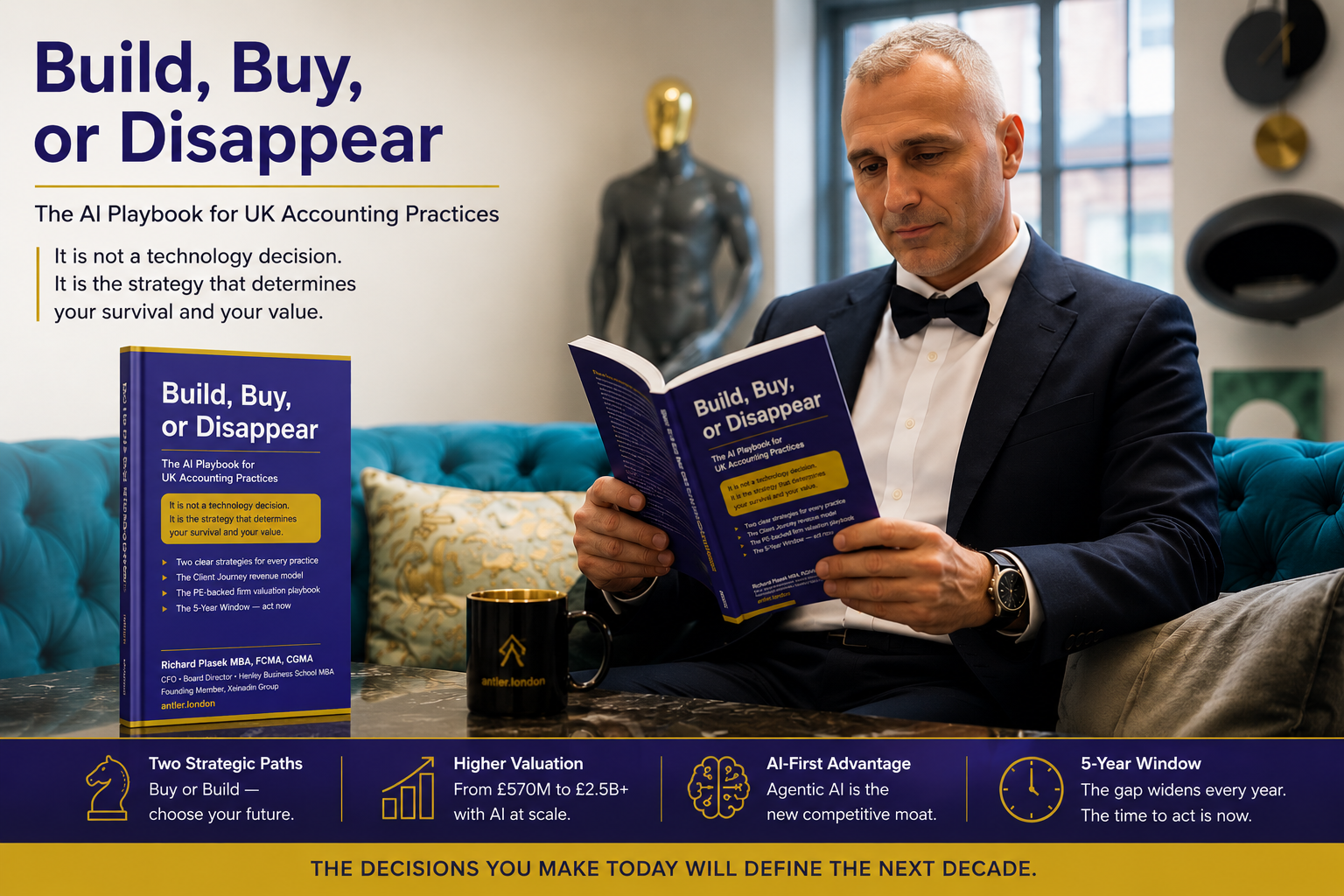
The accounting profession has always evolved alongside technology. From paper ledgers to spreadsheets, from desktop software to cloud-based accounting platforms, every major shift has changed how firms operate and deliver value to clients.
Today, the profession is facing another transformation, one that is far more significant than any previous technological change. Artificial Intelligence (AI) is not simply improving existing processes; it is redefining how accounting services are delivered, how firms compete, and ultimately how practices are valued.
For UK accounting practices, AI is no longer a future consideration. It is a present-day strategic challenge that will influence profitability, growth, client retention, and long-term survival.
The New Competitive Landscape
Many accounting firms still view AI as a productivity tool that can help automate administrative tasks. While this is true, it represents only a small part of the larger shift occurring within the industry.
Several powerful forces are simultaneously reshaping the market:
1. Neobanks Are Expanding Beyond Banking
Digital-first banks are increasingly integrating accounting and bookkeeping services directly into their platforms. Small businesses can now access banking, invoicing, payments, cash flow management, and basic accounting functions from a single application.
As these services become more sophisticated, traditional accounting firms risk losing routine compliance work that once formed the foundation of recurring revenue.
2. Software Platforms Are Becoming AI Companies
Accounting platforms such as Xero, QuickBooks, and Sage are investing heavily in AI technologies through partnerships with leading AI developers.
These platforms are moving beyond bookkeeping software and becoming intelligent business management systems capable of automating data entry, generating insights, identifying risks, and providing recommendations that previously required professional intervention.
3. Consolidators Are Raising the Competitive Bar
Private equity-backed accounting groups have access to significant investment capital, allowing them to implement AI solutions at a scale that many independent firms cannot match.
These organizations are using technology to improve efficiency, enhance client experience, and expand service offerings while maintaining competitive pricing.
4. AI-Native Firms Are Emerging
Perhaps the most disruptive development is the rise of AI-native accounting practices.
These firms are designed around automation from the beginning. With streamlined operations and advanced AI systems, a small team can serve hundreds or even thousands of clients while maintaining impressive margins.
Traditional firms competing against these models may find it increasingly difficult to sustain legacy operating structures.
Why AI Is More Than an Efficiency Tool
Many discussions about AI focus on productivity gains. While reducing administrative work is valuable, the true impact of AI lies in how it changes business models.
The firms that thrive in the coming years will not simply use AI to work faster. They will use AI to:
- Deliver more personalized client experiences
- Create scalable advisory services
- Develop recurring revenue streams
- Improve operational efficiency
- Generate proprietary intellectual property
- Increase firm valuations
The question is no longer whether AI should be adopted. The question is how firms should strategically integrate AI into their business model.
Two Distinct Strategic Paths
One of the most important insights for accounting leaders is that not every firm should follow the same AI strategy.
The appropriate approach depends on the size, structure, resources, and objectives of the practice.
Strategy A: Buy the Best AI Tools
For independent and smaller firms, the most practical solution is often to leverage existing AI technologies.
This approach focuses on:
- Implementing proven AI applications
- Automating repetitive processes
- Improving workflow efficiency
- Reducing administrative overhead
- Freeing staff for higher-value advisory work
Rather than investing heavily in software development, these firms can benefit by becoming highly effective users of available technology.
The ultimate goal is to spend less time on compliance work and more time strengthening client relationships and delivering strategic advice.
Strategy B: Build Proprietary AI Capabilities
Larger firms and PE-backed consolidators may have a different opportunity.
Rather than relying solely on third-party solutions, they can develop proprietary Agentic AI systems trained on their own data and workflows.
This strategy may include:
- Building AI-powered client platforms
- Creating SaaS products
- Launching scalable digital services
- Developing proprietary automation systems
- Generating technology-driven revenue streams
For these firms, AI can become not just an operational advantage but a significant source of enterprise value.
The Valuation Impact of AI
One of the most overlooked aspects of AI adoption is its effect on firm valuation.
Historically, accounting practices have been valued primarily on recurring revenue and EBITDA multiples.
However, investor expectations are changing.
Increasingly, buyers are evaluating whether firms possess:
- Proprietary technology
- Scalable digital assets
- AI-enabled service models
- SaaS revenue streams
- Long-term competitive advantages
A practice with strong AI capabilities may command significantly higher valuations than a comparable firm operating under traditional models.
As technology becomes a larger component of business value, firms that fail to adapt may find themselves at a disadvantage when seeking investment, acquisition, or exit opportunities.
The Importance of Governance
Successful AI adoption requires more than technology implementation.
Accounting firms operate within a highly regulated environment that includes:
- UK GDPR requirements
- Making Tax Digital (MTD) obligations
- ICAEW and ACCA standards
- Professional indemnity considerations
- Emerging AI regulations
Without proper governance frameworks, firms may expose themselves to unnecessary operational and regulatory risks.
Strategic planning must therefore include both innovation and compliance.
The Next Five Years Will Be Critical
The pace of AI development continues to accelerate.
As early adopters gain operational efficiencies, improve client experiences, and develop new revenue streams, the gap between leaders and followers is likely to widen.
For accounting practices, this creates a limited window of opportunity.
Those who act early can position themselves for growth, stronger client relationships, and higher valuations.
Those who delay may find themselves competing in an increasingly difficult environment where technology-driven competitors set new standards for efficiency and service delivery.
A Strategic Guide for Accounting Leaders
For firm owners, directors, partners, and investors seeking to understand these changes, Build, Buy, or Disappear: The AI Playbook for UK Accounting Practices by Richard Plasek provides a comprehensive framework for navigating the transformation ahead.
Rather than focusing on technical implementation details, the book addresses the strategic decisions that accounting leaders must make today to remain competitive tomorrow.
Readers will gain insight into:
- The competitive forces reshaping the profession
- The difference between buying and building AI capabilities
- The emergence of Agentic AI as a competitive advantage
- New approaches to client growth and recurring revenue
- The evolving valuation landscape for accounting firms
- Governance considerations for AI adoption
As AI continues to redefine professional services, accounting leaders face a fundamental choice: adapt strategically, leverage the opportunities technology creates, and build a stronger future—or risk being left behind by those who do.
For anyone involved in the future of UK accounting, this book offers an essential roadmap for understanding one of the most significant industry transformations of our time.